
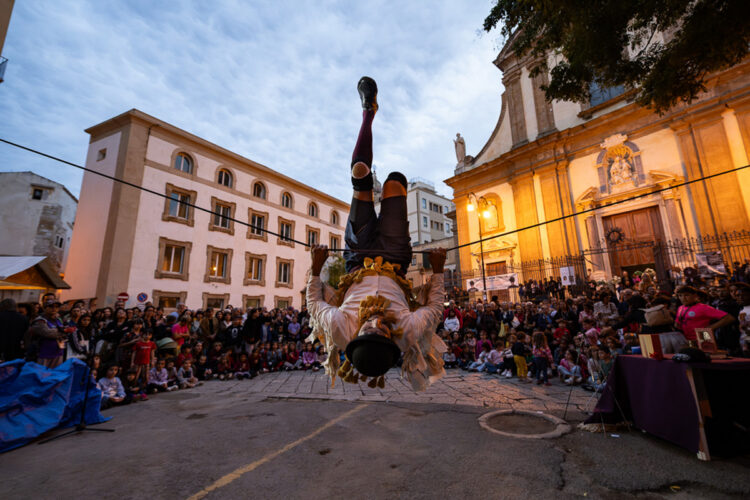
BALLARÒ BUSKERS Contemporary Circus and Street Theatre Festival - The seeds
The Ballarò Buskers Festival 2026 marks the tenth anniversary of a celebration born from a question posed in 2015 by residents and merchants of Ballarò, one of Europe's oldest historic markets in Palermo's heart: how do we bring people back to a neighbourhood once abandoned and criminalised? The answer came through culture and participatory activism.
Since 2016, this free festival has transformed nine public squares over three days in October into a vast open-air artistic stage, welcoming approximately 50,000 visitors and mobilising 170 volunteers, growing from 20 at its inception - a 750 per cent increase reflecting deepened community trust and ownership. The festival emerged organically from SOS Ballarò, a grassroots network that rejected both institutional abandonment and toxic media narratives criminalizing residents and merchants. Rather than external intervention, the network built a participatory infrastructure grounded in listening to concrete needs: fixing broken streets, restoring public spaces, rebuilding economic vitality at the historic market, and reclaiming collective dignity. The festival became the visible manifestation of this year-round civic work, a moment when the neighbourhood celebrates itself and demonstrates a radically different story about Ballarò.
The 2026 edition operates as both a cultural event and an intensive street education programme. Approximately 60 adolescents aged 10 to 16 from the neighbourhood participate actively in festival organisation and management, gaining their first experience of public responsibility and cultural participation. Many encounter live performance and professional artists for the first time while contributing meaningfully to a community project. This intensive 72-hour educational immersion extends year-round efforts, creating pathways for young people historically excluded from cultural institutions to discover that art belongs to them.
Several cohorts have matured into autonomous organisers of their own artistic initiatives, demonstrating long-term impact beyond festival dates. International street arts performers and contemporary circus artists perform using universal languages requiring no linguistic or cultural translation, embodying deliberate commitment to accessibility and inclusion. This artistic choice reflects the neighbourhood's multicultural character while ensuring no one is excluded. Free entry, multilingual information, gender-integrated organisation, accessible spaces for all bodies and identities, and accessible artistic forms together operationalise a radical conception of cultural rights as fundamental rather than elite privileges. The festival functions as crucial civic infrastructure and a "megaphone" for neighbourhood priorities.
Issues identified through year-round community dialogue - substance consumption among young people, urban safety, public space reclamation - gain amplified attention when 50,000 visitors experience them through artistic language and direct neighbourhood engagement. This capacity has contributed directly to shifting regional policy: the festival's visibility and community mobilisation supported advocacy efforts resulting in Regional Law 26/24 on youth substance prevention. This demonstrates how cultural gathering becomes a tool for democratic participation and collective power-building when rooted in genuine community organising. Ballarò, historically narrated only as a site of danger and degradation, becomes annually visible as a place of beauty, creativity, solidarity and generative resistance. Ten years of continuous activation have reclaimed public squares from abandonment and fear. The festival embodies a proven model demonstrating how communities can rebuild trust in shared spaces and reinforce resilience when culture, voluntary participation, and collective decision-making become central to neighbourhood life. The 2026 decennial celebrates not only artistic excellence but a decade of sustained participatory citizenship.
Practical info

Pricerange per day

Accommodation

Food

Main target group

Directions & transport

Surroundings

Average attendence per day

Art disciplines