
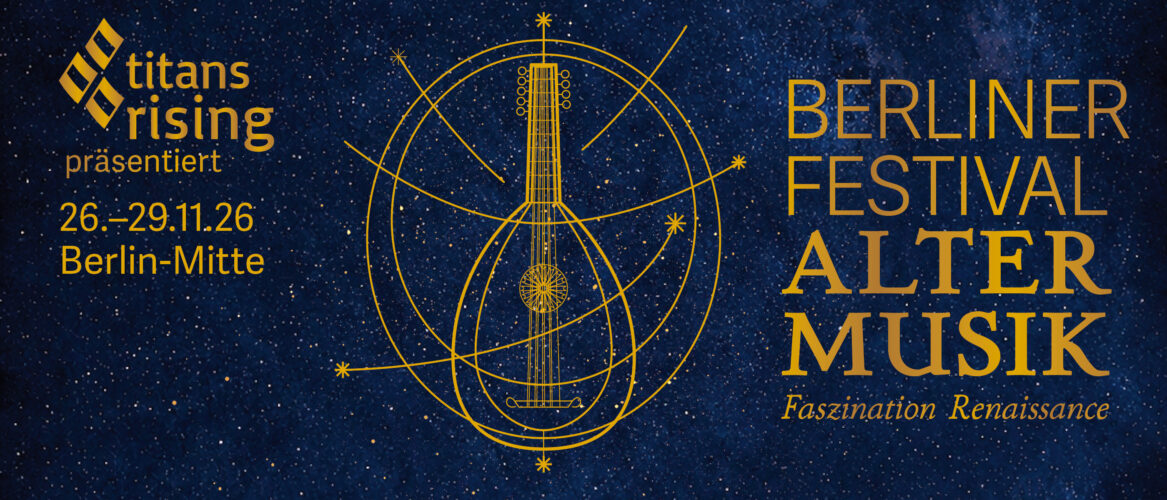
© (c) Verena Postweiler, Titans Rising Verein für Alte Musik Berlin e.V.“
BERLINER FESTIVAL ALTER MUSIK 2026: "Fascination Renaissance"
From 26 to 29 November 2026, the BERLINER FESTIVAL ALTER MUSIK makes its debut under the motto “Fascination Renaissance.” At the Villa Elisabeth, St. Elisabeth-Kirche, Sophienkirche, St. Matthäus-Kirche, and the Kunstgewerbemuseum, Berlin-based and international ensembles unveil the diverse soundscapes of an era whose ideas still resonate today. Historically informed, internationally connected, and with an eye on the present, the festival invites audiences in the heart of Berlin to discover the diversity of an age that gave rise to new horizons between science, art, and social change.
The Renaissance marks a turning point in European history: the transition from the authority of inherited certainties towards free inquiry, critical thinking, and the conviction that humankind can understand the world through observation, reason, and curiosity. This new worldview finds perhaps its most famous expression in Leonardo da Vinci’s Vitruvian Man. Inspired by the writings of the Roman architect Vitruvius, Leonardo placed the human figure at the centre of a circle and a square – between the earthly and the divine. What stands at the center is not humankind as ruler of the world, but the human capacity to perceive, explore, and comprehend it. Almost simultaneously, Nicolaus Copernicus transformed humanity’s perspective once again. According to his discoveries, the earth does not occupy the center of the universe, but revolves around the sun. The order of the universe was not only scientifically provable, but also relevant for collective human understanding.
This spirit of individual inquiry and greater understanding is reflected in the music of the Renaissance. Its intricate polyphony unites individual freedom and collective order in a compelling way. Each voice follows its own path, possesses its own identity and logic, and yet together the voices weave a colorful tapestry of remarkable beauty and complexity. Renaissance music thus becomes a metaphor for a vibrant society: The whole depends upon the strength of its individual voices, while each voice finds its fullest meaning only in dialogue with the others. Understanding arises where voices listen and respond to one another. Where they fall silent, the whole loses depth. In an age of increasing social complexity, this musical way of thinking feels strikingly contemporary. Creativity, specialization, and individual perspectives gain value through their ability to connect with others.
The festival program leads the public through the diversity of the Renaissance and its reverberations, featuring nature-inspired music and Italianate madrigals by Johann Hermann Schein, Venetian frottolas amid glass masterpieces at the Kunstgewerbemuseum, music bringing to life the painted figures of Lucas Cranach the Elder, a Renaissance dance party, a shadow-puppet performance for families, promenade concerts highlighting both an intimate viol consort and a brilliant wind ensemble, the captivating world of the Italian madrigal, the polyphony of the recently discovered Leuven Chansonnier, Jacob Obrecht’s monumental Missa Maria zart, musical discoveries surrounding the little-known composer Caspar Kittel, and an opulent program showcasing music by Heinrich Schütz.
At the BERLINER FESTIVAL ALTER MUSIK, the Renaissance is not regarded as a closed chapter of history, but as an invitation to ask questions. We wish to renew this invitation – through music that tells of the past, inspires the present, and points towards the future.
Practical info

Pricerange per day

Main target group

Directions & transport

Surroundings

Average attendence per day

Art disciplines