
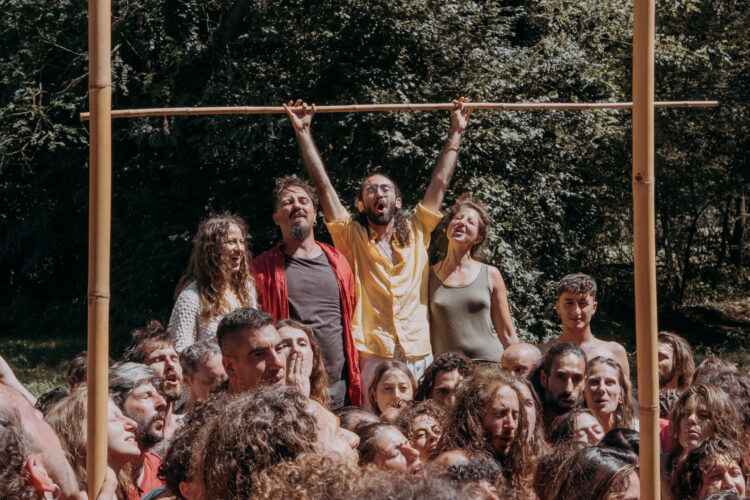
© Marina Dego
Hemera Festival
Hemera is not an event to catalogue. It is not a cultural product to consume. It is an observatory on the contemporary human — a space where thought, body and relationships confront time and landscape. It exists to restore density to experience: to make limits felt, to make silence audible, to make opening possible. Without simplifications, without protections, without reassuring narratives.
Born from Teatro Selvatico, Hemera takes place in Torre Mondovì, in the hills of Piedmont, Italy — a living house, an inhabited organism that shapes and is shaped by those who enter it. During the festival, daily life does not stop: work, artistic practice, care, food, contact with nature and with guests coexist, creating a liminal environment where every gesture becomes an occasion for research.
In a landscape saturated with events that promise pre-packaged emotions and guaranteed transformations, Hemera offers a sharp contrast. We do not give answers — we open space for questions. We do not trace linear paths — we build environments where the complexity of the human can be inhabited, perceived, traversed.
What happens at Hemera
The festival brings together theatre, performance, somatic practices, ritual, music and collective reflection. Workshops are accessible to all, regardless of artistic background, and work from bodies, place, time and atmospheric conditions. Each practice is site-specific, immersive and non-replicable: rooted in the particular landscape, the particular group, the particular moment.
Performances and artistic proposals are selected not to please or create consensus, but to generate presence, tension and thought. Audiences are not guided toward a standardised experience — they are invited to stay, to confront, to tolerate the unfinished.
The methodological roots
The methodology of Teatro Selvatico is not a transferable model. It is built over time, through experience, failure and correction. Its theoretical roots are not references to cite, but genealogies to traverse: the Theatre of Nature of Sista Bramini, the ritual and body-based work of Grotowski, Barba and Jodorowsky, the radical presence of Marina Abramović, the community and political theatre of Boal and the Living Theatre, the somatic and transpersonal approaches of Pierluigi Lattuada's biotransenergetica, and the complex thinking of Edgar Morin.
At the heart of this approach is the concept of "fertile disorientation": suspending habitual coordinates to generate attention, listening and responsibility. The body, gesture, landscape, sound and silence are living matter. Artistic practice and philosophical practice coincide.
Why Hemera is necessary
Today more than ever, there is a need for spaces that do not simplify. Hemera is one of those spaces. It does not promise transformation — it creates the conditions for something to happen. It does not end with the event: it leaves traces, questions, fragments of experience that continue to work in those who pass through it.
Hemera is a path. A trajectory that crosses body, thought, nature and relationships. A place where being fully alive, in authentic relation with others and with the landscape, is not a metaphor — it is the practice itself.
Practical info

Pricerange per day

Accommodation

Food

Main target group

Directions & transport

Surroundings

Average attendence per day
