
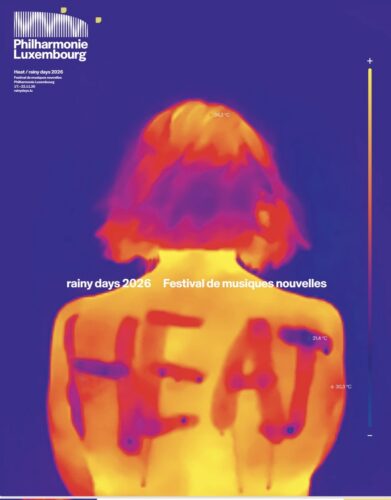
© Philharmonie Luxembourg
rainy days 2026 - heat
This November, rainy days, the Philharmonie Luxembourg’s annual festival of contemporary music turns up the temperature with “heat”, an exploration of energy, friction, transformation and everything that makes us burn. Under the artistic direction of composer Catherine Kontz, the festival brings together leading international ensembles, composers and performers alongside Luxembourg’s vibrant creative scene. Across more than 50 events, concerts, installations, music theatre, experimental performances and participatory projects invite audiences to experience contemporary music in unexpected ways. Heat is a powerful force, both physical and emotional. It can be comforting or destructive, a source of life or a warning of catastrophe. From climate change and the energy crisis to passion, anger, conflict and desire, the festival explores heat in all its manifestations. Musically, it becomes a catalyst for intensity, pressure, repetition, friction and transformation.
The festival opens at the Philharmonie with the Luxembourg Philharmonic performing four contemporary orchestral works, including George Lewis’s concerto for the groundbreaking percussion and piano quartet Yarn/Wire, a new work by Luxembourgish composer Roland Wiltgen and a violin concerto born from a collaboration between sisters Freya and Tamsin Waley-Cohen. Internationally renowned ensembles including the Arditti Quartet, Riot Ensemble, Yarn/Wire, Zafraan Ensemble, Ensemble Klang and United Instruments of Lucilin present programmes ranging from intimate sonic explorations to large-scale, visceral performances. Highlights include Michael Gordon’s monumental Trance, Edgard Varèse’s revolutionary Ionisation, and works by composers Annea Lockwood, Lisa Streich, Stefan Prins and Guilherme Vaz. Throughout the festival, the Philharmonie becomes a living, breathing environment in which music spills beyond the traditional concert hall. A two-hour simultaneous reading of Gertrude Stein’s The Making of Americans, performed by 52 young readers, working with local high schools, transforms the foyer into a furnace of overlapping voices. Elsewhere, lava lamps become musical conductors, a scream choir offers collective release, audiences experience immersive sound through headphones, and installations invite visitors to discover new relationships between sound, space and perception. Participation and exchange remain central to rainy days. The Threshold project, led by violinist Monica Germino, brings young musicians into an experimental performance exploring the boundaries of sound and listening. Encounters with composers, workshops and informal events create opportunities for audiences and artists to connect, while projects for children and families open the world of contemporary music to new generations. A strong commitment to new creation runs throughout the programme, with numerous premieres and commissions, including works by Luxembourg-based composers. The festival actively fosters collaboration between local and international artists, offering a platform for experimentation, artistic development and exchange beyond national borders.
The 2026 edition also extends beyond the Philharmonie through collaborations with the Théâtre National du Luxembourg, Casino Luxembourg and Mudam, strengthening connections between music, theatre and contemporary art. With its distinctive combination of adventurous programming, international artistic exchange and an open, welcoming atmosphere, rainy days challenges traditional concert formats and encourages audiences to explore freely. Whether through the explosive energy of a large ensemble, the intimacy of a single sound or the collective experience of a participatory performance, rainy days “heat” promises a festival full of intensity, discovery and unexpected encounters.
Practical info

Pricerange per day

Food

Main target group

Directions & transport

Surroundings

Average attendence per day

Art disciplines