[Go Green] Into the Great Wide Open
28 - 31 August 2025
Vlieland, Netherlands
Next to its musical, art, children, and culinary goals, Into the Great Wide Open aims to become a fully circular and climate-positive festival, and using this organisational transition to accelerate the larger transitions towards a more sustainable world.
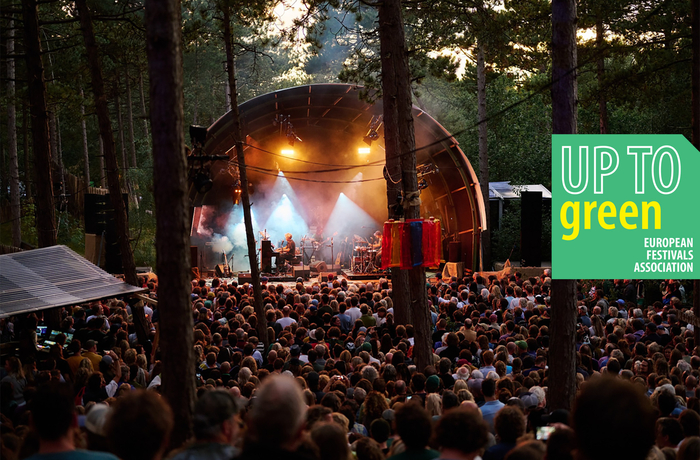
Into the Great Wide Open is a festival that takes place on a small island in the Netherlands. Its total capacity is limited to 10.000 people – including visitors, artists, crew, volunteers and suppliers. Most of the audience is coming from bigger cities and travels from the mainland before taking a ferry.
The Nature 2000 and Unesco World Heritage setting of the Island has inspired the founders of the festival from the beginning to think about the ecological cycles and the ecosystem in which the festival takes place. They wanted to keep this environment as beautiful and pleasant as it was before they organised the festival there. Their vision of trying to become a healthy and regenerative part of the local and global ecosystem stems from this.
The goal of Into the Great Wide Open (ITGWO) – next to its musical, art, children, and culinary goals – is to become a fully circular and climate-positive festival, and using this organisational transition to accelerate the larger transitions towards a more sustainable world. They see the festival as a (1) laboratory, to pilot, to fail and to learn, (2) catalyst, a place to stimulate the marketplace by asking for green alternatives, by being a launching customer, (3) and as a stage, where the exciting stories of innovation, what’s already possible and what an even more beautiful world could look like, be told and experienced.
But what’s meant by this goal? It’s sometimes good to define what is meant by words that are broadly used today.
What is a Circular festival
For ITGWO this concept can be divided into two parts: one relates to circular procurement and the other to waste.
A) Circular approach to waste means that no residual waste should have to be incinerated or sent to landfill; to achieve this all products that have been used during the festival need to be (1) Reused, (2) Recycled, or (3) Composted. This is possible through rigorous planning and organisation of the incoming material streams of the festival, careful sorting of waste streams and good coordination with waste companies.
B) All products that are directly purchased by the festival must be (1) Second-hand, (2) Refurbished, or made from (3) Biobased and/or (4) Recycled raw materials.
This way both procurement and the transformation from residual waste to usable resources support the future circular economy.
What is a Climate positive festival
For ITGWO climate positive means driving down Greenhouse gas (GHG) emissions as far as possible – eventually to zero – and capturing more CO₂ than is emitted, resulting in a net reduction of atmospheric carbon. This applies to scope 1, 2, and 3 emissions, as well as to historical emissions. First the festival is reducing its current greenhouse gas emissions as far as it currently can. After that a calculation is made and the ‘currently unavoidable GHG emissions’ are being removed from the atmosphere – in collaboration with Scature - by regenerative farmers in the Netherlands who store the carbon – stable and long term - from the atmosphere in the ground. After this ITGWO also started removing its historic GHG emissions – approximately 6000 tons – with the European Festival Forest. Every year one earlier edition.
ITGWO does not see this as compensation or wants to claim Net Zero status, but as a taking up responsibility for its own emissions and supporting and helping to develop a natural carbon storing sector that is trustworthy, stores carbon long term and creates huge co-benefits; healthy soil, good food, biobased building materials, clean water, biodiversity, extra income for farmers, etc.
Driving down GHG emissions through Travel and Transport
Looking at the breakdown, it's typical to see that travel and transport make up a very large proportion of the festival's total emissions. For Into the Great Wide Open, this share was 63% in 2024, releasing around 200 Tonnes of CO2. 75% of this was visitor travel, mainly fossil car use. The aim is to reduce CO2 visitor travel as far as possible, and get as many people to switch their, slow, unhealthy, noisy, and traffic jam causing fossil cars (:-) for the much smarter, comfortable and even cheaper – yes cheaper - fossil-free travel option.
To get audiences to make this switch, they are encouraging fossil-free modes of transport by changing the (fossil advantaged) playing field, under the Green Travel Programme. One intervention is the Green Travel fee. Included in every ticket sold, there is 15 euros Green Travel Fee, which visitors can claim back if they use fossil-free means of transport. This is a financial incentive for people to travel fossil-free, and effectively makes the fossil free option cheaper than the own fossil car – running costs + parking fees + fuel. This is a good way for the festival to influence travel behaviour.
A financial incentive on its own only goes so far, that’s why a combination of green travel incentives – financial, social, green travel options, ease of use - is being deployed. There are fossil-free festival buses, and partnerships with electric car-sharing companies. There is a FIP (Fossil free Important People) programme and campaign, that gives people who travel fossil free all kinds of funny VIP advantages and social push “you can’t buy a FIP membership, you can only earn it”. Most festivals are not keen on threatening or telling their audiences what to do – but through these soft but strong interventions they can have a huge impact on social norms and promote behavioural change.
What proves this is the drop in fossil car use. In 2018, 72% of the ITGWO visitors came by car in 2025 this has dropped to 48%, a drop of almost 25%. The other main modes of travel, 52% are now coming on foot, (electric)bicycle, sailing, train (100% wind power and last bit on HVO), fossil free festival bus (electric and HVO), and (shared) electric cars.
Funding the transition to more sustainable festivals
The Green Travel Fees that are not claimed back by visitors – fossil travelers or fossil free travelers that donate the fee – are put in the ITGWO Transition Fund. This fund is developed as a financial instrument for organisations that want to speed up their own transition towards more sustainable operations. This money funds 3 things:
- Sustainable innovations that drive down emissions and other environmental impact.
- Removal of all (not yet preventable) residual emissions scope 1, 2 & 3 (€90 per ton).
- Removal of historic emissions (currently one earlier edition per year, €20 per ton).
This effectively creates:
- an internal carbon price/incentive (€90 per ton of CO2) which makes every low carbon production decision by anyone in the organisation relatively cheaper.
- an earmarked budget to let all parts of the organisation and supply-chain start sustainability projects that improve the environmental impact.
- frees up the budget to fund projects (Festival Forest, regenerative farmers in the Netherlands through Scature) with huge co-benefits, to retrospectively remove residual and historic GHG emissions from the atmosphere.
This combination of putting the incentives in the right direction, strong determination and many years of experimenting, failing, learning and hard work have brought Into The Great Wide Open where it is now. Not fully circular and climate positive yet, but on its way… and sharing the story.